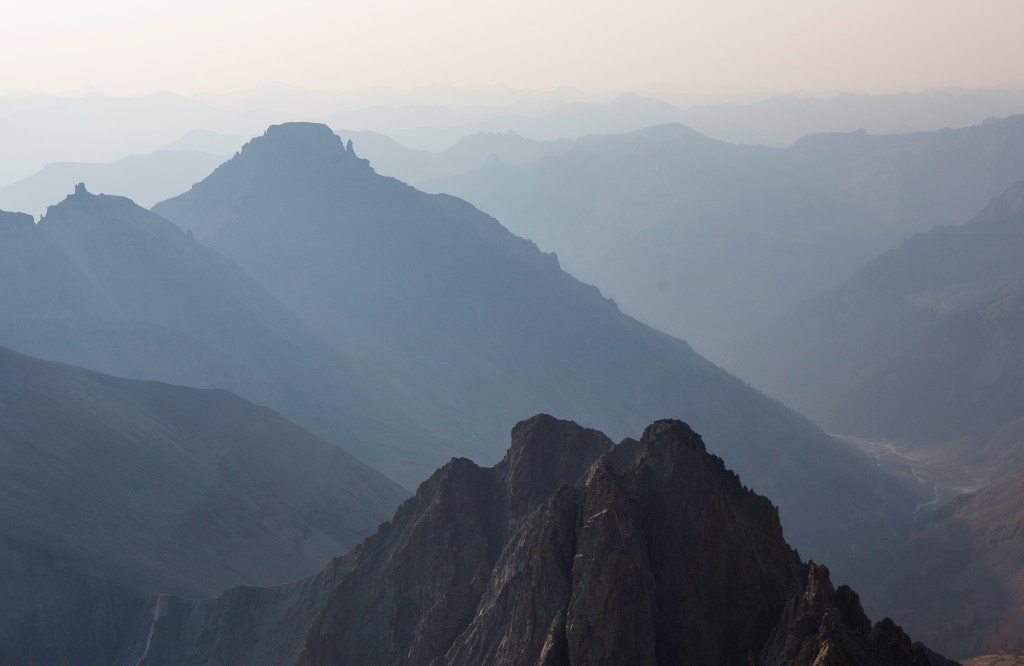
When night fell, Frankie Black heard the roar of flames in the canyon as the fire grew closer. The horizon was painted red with an intense heat as a black cloud of smoke covered the sky. Ash rained from the sky. Black never saw a volcano erupt, but she imagined it to be something similar to the landscape before her eyes. The fire consumed the trees, leaving behind a charred skeleton of the once scenic mountainside. In the mornings, planes and helicopters would rev their engines and battle the fire from above, dumping slurry across the blaze. “It’s just too much,” Black said.
Wildfires raged across millions of acres in the western United States this year with a record-breaking intensity that many scientists believe is a result of a changing climate. Warming global temperatures are creating hotter and drier conditions with less moisture, the perfect environment for fire to become out of control.
Since the beginning of 2020, more than 8,500 wildfires have burned across 4.1 million acres in California. In Colorado, the Pine Gulch and Cameron Peak fires are two of the largest fires in the state’s history, eating away almost 300,000 acres of land. Although the climate is a large contributor to these catastrophic wildfires, human fire suppression is one of the leading causes of the flames charring the West. “We’ve been waiting for this kind of event for a long time,” Forester Richard Kime said.
In the western forests of the Sierra Nevada and the Rockies, fire is an important natural function of the ecosystem. Historical fire frequencies in these areas have been much higher than they are today. Fires used to occur every three to five years, Kime said. Once people began regulating these forests, the frequency dropped to zero. “For centuries the fires stopped completely,” Kime said. “Now we have 100 years of fuel burnup as a result of that loss of fire. It’s very clear this buildup is the reason these fires are so large and difficult to contain.” When fire happens every several years, it consumes mostly low vegetation, brambles and grass and trees remain unharmed, Kime said. In a fire-associated ecosystem, trees are widely spaced in open forest. With the absence of fire, the forests have maintained denser growth and accumulated more potential fuel. “Now instead of a ground fire, these are crown fires,” Kime said. “We are witnessing extreme fire behavior. The fire burns to the tree-tops and is much more intense.”
The flames trapped Black in her home in Glenwood Springs, Colo. She pondered the looming possibility of an emergency evacuation, but as it moved closer many of her neighbors decided to leave. “You couldn’t run from the smoke,” Black said. “I could go through the house with wet cloth and constantly wipe the black soot. It would permeate through the walls and through everything.” One route of escape traveled west toward Grand Junction. But the city was battling its own rapidly spreading Pine Gulch fire, burning only 18 miles north of the city.
Although Salida was spared, Colorado Mountain Club Conservation Director Julie Mach watched the fires consume the western part of the state.
“We are seeing fires at times of the year when we didn’t use to, like the large fire in Colorado that occurred in February,” Mach said. “As we see snow lines get higher and higher, we are going to see the potential for fire at earlier and later times in the year.” Fire seasons are lasting an average of 30 days longer than they used to, Mach said, and they are burning out of season.
Increasing human development near and into previously undeveloped natural areas, known as the wildland-urban interface or WUI, have made forest management and fire-fighting more costly, challenging and dangerous.
According to the National Interagency Fire Center, the federal government spent an average of $2.4 billion on fighting wildfires between 2014 and 2018, more than twice what was spent 20 years earlier. Undeveloped wildlands offer extensive opportunities for outdoor recreation, aesthetic and personal advantages of living, a U.S. Forest Service press release stated. But in contrast to the benefits of WUI, living in these zones has risks. Infrastructure (cell towers, schools, water supply facilities, etc.) often mixes or is adjacent to wildland, zones highly vulnerable to wildfire.
President Donald Trump pushed the need for better forest management to reduce fire risk, Ecologist Kristin DeMarco said. But management techniques such as fuel reduction treatments and selective logging are expensive tools and often not effective. The long-term solution is the reintroduction of fire, DeMarco said. But most don’t have a concept of what a fire dominated landscape is like. “They haven’t seen it in their or their parents’ or grandparents’ lifetimes,” DeMarco said. “It is a social challenge to solve this problem in a more systematic way. These fuel loads get bigger every year and it is not going to stop.”
Black watched the blood red sunrise. It filled her with a sense of both beauty and fear. “I can’t imagine what the firefighters went through on the steep mountain slopes,” Black said. “To think that they were fighting a battle between the canyon, the river and the railroad with the heat of a raging fire going in all directions. It’s just too much.”
 Bella Biondini