No signs of life existed. Plants withered and the city faded to the color of dark gray ash. The birds fell silent, and nothing stirred on the landscape, not even a lizard. When night came, it was pitch black except the light coming from Christine Ferry’s porch and the house across the street. They were alone.
“We had the clothes on our backs,” Ferry’s husband, Theron said. “We didn’t take pictures or photographs. We thought we would be back in a day or two just like we had done a million times before.”
Murky water festered in their home for over a month before they returned. Their sofa was covered in fuzzy yellow mold, and mud caked the floor. Her son cried for the stuffed green dinosaur he used to sleep with. Theron Ferry dug through the muck to find it. They washed the dinosaur countless times, but the stench of floodwater never left.
“We had nothing,” Christine Ferry said.
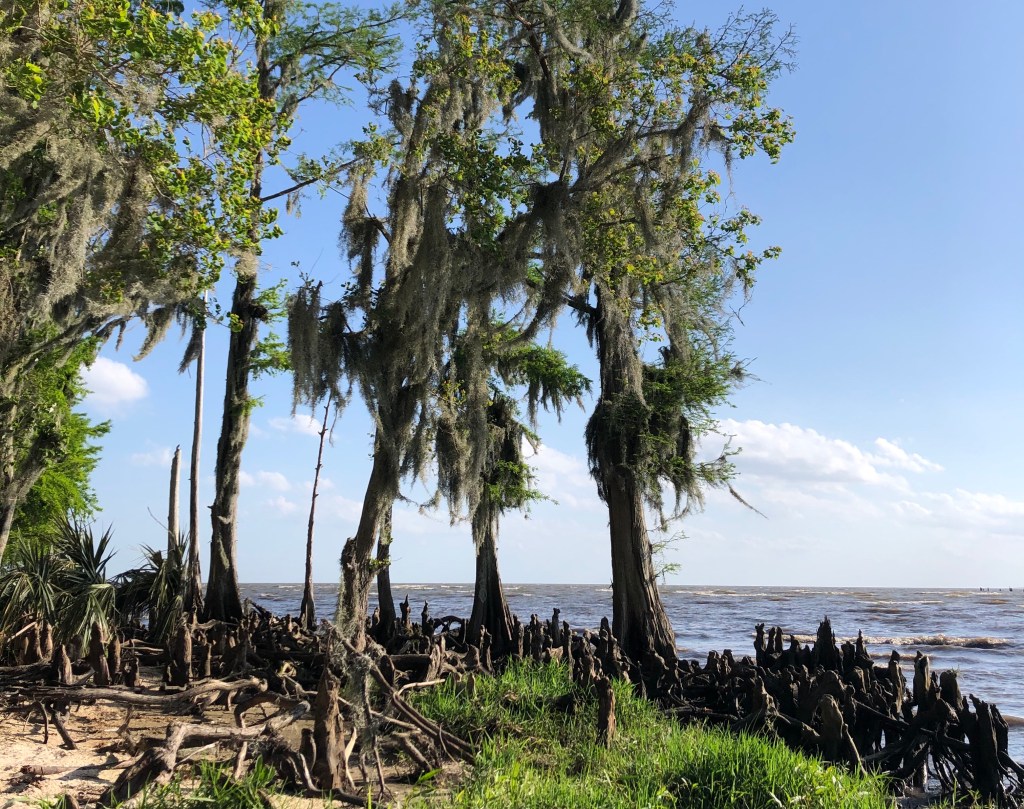
Climate change is dramatically increasing the vulnerability of coastal Louisiana to another devastating hurricane by accelerating the rate of sea level rise and subsidence, experts say. The planet is warming and the sea continues to creep farther inland, eating away at the coastline.
After Hurricane Katrina, New Orleans faced uncertainty. The water came without mercy, leaving millions homeless in the debris. For researchers, it is difficult to model the precise effects of climate change on hurricanes, but the statistics are alarming.
“Louisiana is the most vulnerable state in the U.S. when it comes to climate change,” Louisiana Climatologist Barry Keim said.
Relative sea level rise is the addition of rising global seas from processes like glacial melts combined with erosion and sinking of land masses.
It’s likely that 85% of New Orleans will be below sea level within the next century, according to National Oceanic and Atmospheric Administration projections.
Sea level rise in Louisiana, combined with subsidence, or the gradual sinking of the land, rivals some of the worst places in the world, Keim said. It is becoming harder and harder to keep the water out, and then you throw in a hurricane with a storm surge. He sighed.
The science community disagrees on the potential impact of climate change on storm frequency. Is the probability of another hurricane with the power of Katrina increasing?
Hurricanes are a planetary function formed by a surplus of energy at the equator. The idea behind climate change is an increase in this energy.
Hurricane Climatologist Jill Trepanier said researchers did not expect the overall number of storms to increase but to become more intense over time. Storms were likely to become slow moving, dumping devastating amounts of rain on the landscape in short intervals.
“Katrina was a historical marker, but it really should be the 2005 season, with 27 named storms and a disproportionate number of major storms such as Wilma and Rita,” Trepanier said. “That big ramp-up in energy was a good indication that there’s a lot more energy being transferred than before.”
Hurricane Katrina made landfall in Louisiana as a Category 3 storm on August 29, 2005, its diameter covering the entire Gulf of Mexico. Wind speeds reached up to 125 mph, and heavy rainfall and a storm surge led to breaches in the city’s crucial levee system.
Regan Broussard was 6 years old when her family evacuated. She remembers walking down the stairs the morning the floodwaters rose. Her family gathered around the television in tears, she said. Broussard asked her mother when they could go home.
“We can’t,” Broussard’s mother responded. “There is no home.”
Fourteen feet of water filled their house. When they returned, the ceilings hung down from the moisture like piñatas at a Mexican restaurant. The water destroyed everything in its wake.
Research at the Southern Climate Impact Planning Program projects sea level rise as high as two meters by 2100. The speed of sea level rise in Louisiana is accelerating, rising as much as one inch every two years. Tidal gauges measured a 24-inch rise since 1950 in Grand Isle. NOAA scientists forecast another 10 inches in the next 15 years. The addition of a powerful storm and surge would prove catastrophic for the low-lying areas of coastal Louisiana.
Storm surges occur when water rises above its normal level and is pushed inland by high winds. Rising sea levels create a higher starting point for flooding and potential storm surges.
SCIPP Research Associate Amanda Lewis said she is worried about the future of the Louisiana Gulf coast.
“It’s a huge fight against nature,” Lewis said. “We take one step and nature takes two steps. We are always one step behind.”
Hurricane Katrina, a lesson hard learned, remains prominent in the memory of the Crescent City.
A survey that sociologist Renee Edwards conducted found a small percentage of the population who would not evacuate from their homes in the face of a storm or flood, regardless of the risk. That concerns her because the unstable climate would cause the likelihood of these events to increase, she said.
“There’s a lot of research that shows the more time that passes after a big storm, the more people forget the negative impacts, and the less likely they are to engage in preparations,” Edwards said.
The news media is tasked with getting information out to the public, and they do a good job of reminding people how to be prepared, she added. But people pay less and less attention as the time goes on.
Ferry said she doesn’t worry about another storm, the broken levee was responsible for the inundation of the city.
“It was a once in a lifetime thing,” Ferry said. “I can’t see it happening again.”
A report by the U.S. Army Corp of Engineers concluded that insufficient preparation, funding and poor maintenance led to the failure of the levee system. This allowed the floodwater to fill low-lying Orleans and Jefferson Parish, the majority of the area already 4-10 feet below sea level.
Former Louisiana State University Hurricane Center Director Ivor van Heerden called New Orleans the Cajun Atlantis. He warned state authorities for years of the inevitable catastrophe that would befall the city and southeastern Louisiana: a total drowning. Van Heerden described Hurricane Katrina as both a natural disaster and a systemic failure.
“If science and engineering had been allowed to play their proper role in the development of policies for the wetlands and levees, we wouldn’t be in this situation today,” van Heerden said. “If nothing changes in the future, one fifth of the state of Louisiana will disappear beneath the waves, gone for good and we will have no one to blame but ourselves.”
The construction of levees, made to protect the city from flood water, only caused more irreversible damage to New Orleans’ natural storm barriers, van Heerden said. The Mississippi River is no longer able to flood and spread sediment across its banks to build new land. A Coastal Wetlands Planning, Protection and Restoration Act funded study revealed that the weight of this displaced sediment is causing coastal Louisiana to sink an average of 9 millimeters per year.
The government took measures to strengthen the coast and the city’s preparedness after Hurricane Katrina. The city would rebuild but faced grim climate statistics.
The Coastal Protection and Restoration Authority was formed in 2005 in the wake of Hurricane Katrina to study and model future scenarios including climate change through adaptive management and flood preparation.
“We needed a single voice for protection and restoration in Louisiana,” Strategic Planning Administrator Stuart Brown said.
The future conditions of coastal Louisiana are uncertain because of the complex dynamics of natural and socio-economic systems of the region, he said. But the city is more prepared than it was in 2005. The Atlantic hurricane season begins on June 1 and extends until November 30. Rising sea temperatures will soon fuel the tropical storms of the 2020 season.
Each year on the anniversary of Hurricane Katrina, the Broussard family places a white flower in Lake Pontchartrain in memory of all the people who died.
Ferry rebuilt her home and still lives there 15 years later. But Louisiana’s climate continues to be unpredictable. The Great Louisiana Flood of 2016 destroyed her aunt’s home where her family sought refuge during the aftermath of Katrina.
“We helped gut her house, but it was the exact same smell,” Ferry said. “It was like being back in Katrina. You never forget.”
 Bella Biondini